Mukha
Menu
← Back to services

Mukha / See the deliverable

A clearer picture of your system. In writing.

Before you request a System Clarity Review, see the kind of questions we examine, how we connect findings to evidence, and what your team can use to decide what to do next.

Fictional demonstration. Harborline Parts and every system, record, finding, and evidence identifier in this report are invented. This is an example of the deliverable format—not an actual client assessment or a claim about completed client work.

PDF · 12 pages · No form or email required to view

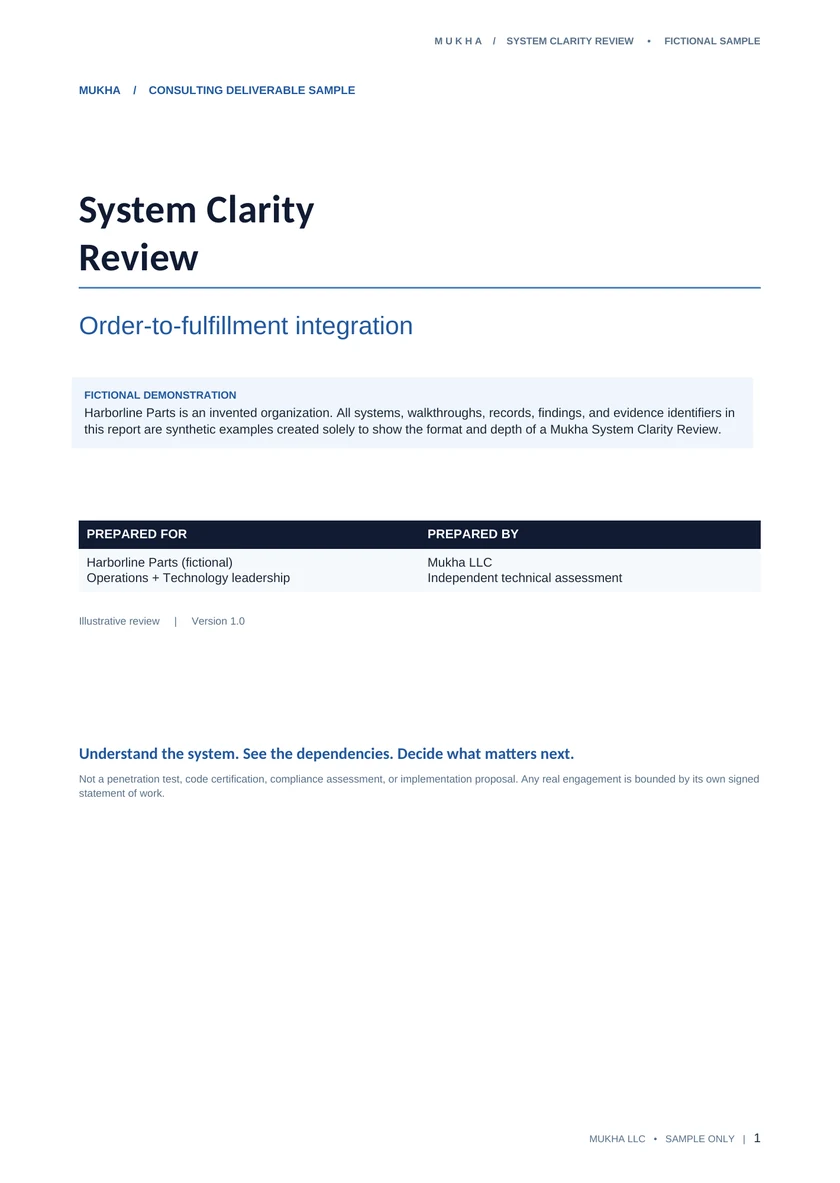
Cover of the fictional Mukha System Clarity Review for Harborline Parts
Illustrative sample / Harborline Parts01 / 12

The written handoff

What you can expect to see

A review should make a decision easier—not leave your team with an impressive-looking document and no clear next move. This sample shows how observations, dependencies, and next actions fit together.

01 / REPORT

Executive summary

The central issue, the business consequence, and the decision that needs to be made next.

02 / REPORT

Scope and evidence

What was examined, what was not, which artifacts support the observations, and where uncertainty remains.

03 / REPORT

Current state and dependencies

How the workflow operates today, how information crosses systems, and where ownership changes hands.

04 / REPORT

Findings and risks

Specific, evidence-linked observations with likely consequences, recommended actions, and verification checks.

05 / REPORT

Recommended next actions

A sequenced plan, the decisions required from your team, and clear criteria for knowing the work is complete.

The point of the review

Know what to decide—and what still needs proof.

The report distinguishes documented observations, inferred risks, unanswered questions, and work that requires a separate implementation scope.

Explore all report sections ↗

Inside the fictional case

What an order-to-fulfillment review can reveal

In this invented scenario, an order crosses a website, integration service, ERP, warehouse provider, and carrier gateway. A failure at one handoff can appear to be a problem somewhere else.

01

Commerce Portal

Order captured

02

Integration Service

Transmit + retry

03

ERP

Order + inventory

04

Warehouse Platform

Pick + dispatch

05

Carrier Gateway

Tracking response

Simplified logical path for the fictional sample, not a network or security architecture diagram. The full PDF includes the separate inventory feed and interface failure boundaries.

F01

An uncertain ERP response can create duplicate orders

Illustrative evidence: Synthetic order traces (E02)

Why it matters
A timeout does not prove that an order was rejected. Retrying as a new order may create a second fulfillment request.
Recommended action
Define one durable external order identifier and a safe retry or reconciliation procedure.
How to verify
Replay an ambiguous timeout and confirm that one customer order produces no duplicate ERP order.
F02

Displayed inventory may be older than the fulfillment record

Illustrative evidence: Illustrative batch schedule and feed schema (E03)

Why it matters
A nightly export can leave the website showing availability that no longer matches the ERP.
Recommended action
Make feed age visible and agree how checkout behaves when stock information is stale.
How to verify
Simulate a missed export and confirm that stale information is detected and handled explicitly.
F03

An integration account has broader access than its stated duties

Illustrative evidence: Invented access matrix (E04)

Why it matters
An over-broad integration identity expands the impact of an account error or compromise.
Recommended action
Assign an accountable owner and restrict permissions to documented integration operations.
How to verify
Confirm that necessary order and status operations work, while unrelated ERP actions are denied.

These findings are invented for demonstration. They do not represent measured incidents, proven vulnerabilities, or outcomes achieved for a real client.

Scope and expectations

An assessment, not a disguised implementation project.

A real System Clarity Review covers the specific workflow and systems agreed with your team. Its findings depend on the access, artifacts, and evidence actually available during the engagement.

It does not, by itself, include production changes, a penetration test, a formal compliance audit, or a commitment to replace or implement software. Any subsequent work is separately scoped and approved.

The sample illustrates the structure and level of explanation; the real report's length, findings, timeline, and recommendations will vary with the signed statement of work and what can be verified.

Start with clarity

Tell us what is difficult to understand in your system.

Describe the workflow, the uncertainty, and the decision you need to make. We'll use your intake to determine whether a focused review is the right next step.