Mukha
Menu

Mukha / Sample review / CMS ecosystem

CMS problems rarely stop at the CMS.

See how a focused System Clarity Review can map the web estate, document ownership, vendor dependencies, migration boundaries, and editorial workflow before a replacement project begins.

Fictional demonstration. Cedarline Professional Network, every system, account, artifact, and finding in this report are invented. This is a sample deliverable, not an actual client assessment or testimonial.

PDF · 12 pages · Fictional sample · No email required to view

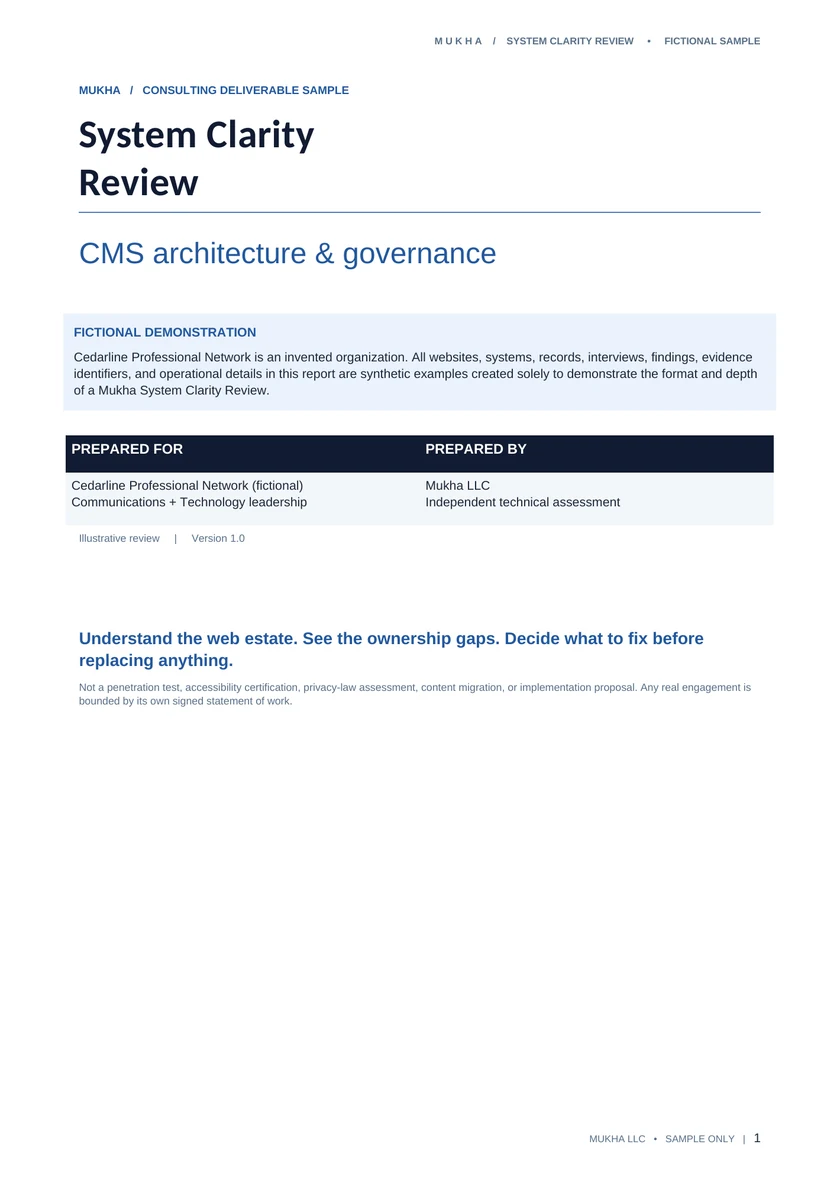
Cover of the fictional Mukha CMS Architecture and Governance System Clarity Review
Illustrative sample / Cedarline01 / 12

The question behind the review

“What actually runs our website—and what would break if we changed the CMS?”

In the fictional scenario, the organization is considering a CMS replacement. The review finds that the public web experience also depends on external forms, search indexing, document locations, legacy microsites, a member portal, domains, and vendor-admin accounts. Replacing the CMS alone would move only part of the system.

01 / REVIEW

Web estate

Map the CMS, files, forms, microsites, domains, search, and authenticated handoffs.

02 / REVIEW

Ownership

Identify who controls content, vendor accounts, renewals, credentials, and recovery.

03 / REVIEW

Migration boundary

Decide what must migrate, integrate, retire, or remain intentionally outside the project.

Illustrative ecosystem

One website can depend on many systems nobody calls “the CMS.”

The sample maps the primary CMS together with external search, public forms, document locations, a member portal, legacy microsites, domains, and vendor accounts. The point is not to make the diagram complicated; it is to make hidden ownership and handoffs visible.

Public website

Rendered public content

Document locations

CMS media + shared storage

External search

Pages + document discoverability

Primary platform

Primary CMS

Pages, media, navigation, editor roles, templates, and publishing workflow.

A migration decision still depends on systems and ownership outside this box.

Forms SaaS

Public forms + routing

Legacy microsites

Campaign + event properties

Domains + vendor accounts

DNS, renewals, admin ownership

Member portal

Authenticated member services

Example findings

Findings are tied to consequences and verification—not just observations.

F01 / High

Page restrictions do not reliably protect linked documents

Why it matters
A file can remain reachable by direct URL even when the page that linked to it is hidden or unpublished.
Recommended action
Classify restricted documents and enforce access at the file or application layer, not only through CMS page visibility.
F02 / High

Critical web administration is not fully organization-controlled

Why it matters
Vendor changes, staff departure, billing lapses, or account recovery can interrupt service when ownership lives in personal or unclear accounts.
Recommended action
Move critical administration into company-controlled identities with named primary and backup owners, MFA, and documented recovery.
F03 / High

The proposed CMS migration boundary is incomplete

Why it matters
A project can migrate pages while leaving microsites, forms, search behavior, document stores, domains, and vendor dependencies behind.
Recommended action
Inventory the full web estate and classify each capability as migrate, integrate, replace, retire, or explicitly out of scope before platform selection.
F05 / Medium

Editorial workarounds are compensating for workflow design

Why it matters
A replacement CMS can reproduce the same friction when requirements come from the current configuration instead of real publishing scenarios.
Recommended action
Design and test the future workflow against representative routine, urgent, shared-ownership, and rollback scenarios.

Publishing operating model

Content governance is part of architecture.

The report follows content from draft through retirement and calls out where urgent workarounds or undefined ownership can create the same problems regardless of which CMS product is selected.

01

Draft

Department editor

02

Review

Subject owner

03

Publish

CMS workflow

04

Distribute

Search + links

05

Maintain

Content owner

06

Retire

Archive / remove

The decision this sample supports

Stabilize first. Then decide what to replace.

The fictional review recommends a short inventory and ownership phase before approving a CMS replacement. The goal is not to defend the current platform; it is to make the replacement boundary explicit enough that leadership can make a defensible decision.